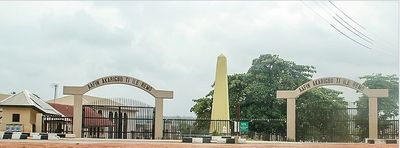
Makun Community of Sagamu is a combination of urban and rural
settlements. It is an important area in the present Sagamu Local
Government Area of Ogun State. It has boundaries with Ofin in the
township and in the rural areas. It has boundary with Epe in the urban
area. It has boundary with Sonyindo in the urban and the rural areas. It
has boundary with Ibido and Igbepa both in the urban and rural areas.
It has boundary with Ijagba both in the urban and the rural areas. The
last boundary mates are the Egbas of Owode in Obafemi/Owode Local
Government Areas of Ogun State, and this is in the rural areas.
Makun is one of the thirty-three Remo traditional towns that made up
Remo Division, the smallest and the most vibrant division in the old
Southern Provinces of Nigeria. Makun is one of the thirteen traditional
towns that federated and gave birth to the present SAGAMU in 1865.
There are two separate historical assertions about the origin, migration
and settlement of the Makun people. The two assertions are not
conflicting in nature. The first one merged with the second one, hence,
there is a merger and there is little or no difference in the two
schools of thought.
The first assertion stated that Makun originated from the ancient city
of Ile Ife. They were from the Iremo quarters of Ile Ife. The general
assertion of the whole of the communities in Remo is that each one of
them moved out from the Iremo quarters of Ile Ife. There is the
consanguinity traits among all the Remo towns. Remo is applied to bring
the whole batch of them together in this division. Remo is coined out
from Iremo in Ile Ife.
It is stated that there were two brothers, Arapetu and Liworu. Arapetu
was the elder brother whilst Liworu was the younger brother. They were
siblings. Their mother's name was Ewusi. They were not direct sons of
Ooni of Ile Ife, but they were of the Royal blood of Ile Ife. The two
brothers decided to migrate out of the ancient city of Ile Ife to settle
on their own. The assertion stated that they left Ile Ife with Royal
paraphernallia such as a crown, the Oro, Eluku, Pakoko, Agemo, Ferewa
(Olire), Ogun and blacksmithing. They migrated southwards with their
mother, wives, children and other relatives. How many they were at their
take-off point were not known or mentioned. The routes of migration and
partial settlements during the migration were already forgotten and
lost in history. The assertion made it abundantly clear that they came
to the present Ijebu Ode settlement and they were received with
open-arms by the Awujale of Ijebu Ode into the Ijebu Ode Royal
household. The implication of the settlement into the Royal household
was that there was blood relationship with the Awujale. History had it
that some other Remo towns passed through Ijebu Ode and they were not
entertained or received into the Royal household of the Awujale, but
they settled in the sub-quarters of Ijebu Ode before they moved out
again to continue their migration.
The second assertion of the history of Makun pointed out that Makun
people are part of Ijebu Ode. It says that Makun was the son of the
tenth Awujale of Ijebu Ode, the Obaruwa. Obaruwa reigned after Alayeluwa
Ofinran and Alayeluwa Obanganju reigned after him. The first Awujale
with an accurate recorded date was Gbelegbuwa I who reigned from 1760 to
1789. Awujale Gbelegbuwa I was the forty-fourth Awujale of Ijebu Ode on
the throne.
At the Ijebu Ode settlement, it was said that Makun people were first
headed by one Oso, after Oso's death, there was another leader in the
name of Osoribiya. The two historical assertions of Makun cannot be
thrown overboard. The belief that they came from Iremo quarters of the
ancient city of Ile Ife is still admissible. The belief that they are
the children of Obaruwa, the tenth Olu of Ijebu Ode cannot be jettisoned
either.
Makun however, left Ijebu Ode under the leadership of Osoribiya and they
migrated towards the river-rine area of Ijebu land. They settled down
as a community. The date and duration are not known. The community
founded then is the present Makun Omi. The Makun people again left the
new settlement and moved southwestwards. They left a remnant of their
people at Makun Omi, hence, the continuous existence of that community
up till today. They trekked towards Oko Mayan river, a place very close
to Okun Owa. After a short stay at Oko Mayan side, they moved again,
passed Okun Owa and trekked towards the fringes of the present Owode
Egba. How long it took them on the journey was not known. They settled
close to Owuru River. The Makun people and the Egba people inter-married
because of their proximity. Makun Community and the Egba people by the
virtue of the intermarriages have close relationship with each other.
Despite the marital relationship with the Egbas, the Egbas were very
hostile to Makun people. This was due to the territorial ambition of the
Egbas. Land proclivity, booty and slaves were choiced material of the
Egbas, hence, the Makun people who were then their close neighbours were
not at rest. They were exceedingly hostile to Makun people, therefore,
there were several wars between the Egbas and the Makun people.
Makun was forced out of their settlement on the Owuru river. Owuru river
is the first river towards Lagos after leaving the present Gateway
Paradise City. Some of the landed property on the right towards Owuru
which the Egbas occupy today are Makun land. Makun moved to another spot
to settle in order to avoid further confrontation with the Egbas. The
new settlement was named Agege, not Agege of Lagos. They were not left
alone again at Agege, they moved away from Agege and settled at Badore
because of the Egba hostilities. Badore is the present junction of
Likosi-Simawa-Okerala joint road, a few metres to the present Simawa
settlement. The villages around, Simawa, Ewu Eleku, Ewu Losi, Likosi,
Okerala, Igbowaju. Araromi, etc had once built a market at this
particular place. The market had long defunct. Simawa is now extending
very rapidly to the site of Badore. Hopefully, Badore will be taking
over its past glory of township in the very near future. The Egbas
attacked Makun at Badore on March 3, 1851 and destroyed the Makun
settlement. Makun survivals took refuge at Ikorodu. Balogun Jayesinmi
was the head of Makun warriors then. The Egbas took occupation of
Badore. At Ikorodu, Balogun Jayesinmi died and another Balogun was
appointed. Ewusi Inanuwa I was the Ewusi of Makun then. The new Balogun
was Olumeru. Balogun Olumeru was not happy that the Egbas drove them out
of their settlement, hence, he reorganised his forces and marched them
to Badore. He attacked the Egbas in a do or die affairs. The Egbas were
defeated in the battle. This was in 1852.
After the defeat of the Egbas at Badore, Makun shifted their base and
they trekked to Agbele and settled down. They came to Agbele in 1852
under Ewusi Inanuwa I. The Ibido and Igbepa communities were met at
close distance from each other. The two communities became close
associates of the Makun community. Therefore, the three
communities-Makun, Ibido and Igbepa had since been regarded as one
family. The Egba hostilities did not abate after Makun's settlement at
Agbele. They waged several wars against Makun.
The tocin of war was resounding in Yorubaland. There were welters of
poverty and want in Yorubaland. It affected everybody and every clan.
There were the following wars to mention a few.
The Makun war of 1782
The Owu war of 1817- 1824
The Owiwi war of 1833
The Egba - Dahomey war from March 3, 1851
There was the Ijaye war from April 10, 1860 - March 17, 1862
The Kiriji war of 1877 to 1893.
Makun was not exempted from some of these wars. Makun even had its own
problems with the Egbas and the Awujale through their invasions. There
was the special Makun war, the immediate course was the Elepe's crown.
Makun was destroyed many times. The second Egba-Dahomey war started on
June 19,1862. They pitched their camp against Makun at Agbele. Makun was
in such a very serious precarious situation that they retreated to
Ikorodu on March 23, 1865. The Egba-Dahomey soldiers took occupation of
the Agbele Makun settlement. Balogun Olumeru was very unhappy about the
situation and their running away from their adversaries, therefore, he
mustered up the courage of his men of arms and told them in bold terms
that they had to go back to Agbele and face the Egbas and their allies.
They fought very gallantly and Balogun Olumeru lost his life and some of
his men during the battle. Another Balogun was appointed during the
war. This was Sosimi. He was tall, handsome and very powerful. He had
under him military officers or generals such as Kayin-ogun, Agaga,
Ogunsile, Lajiga Osinuga (Alias Lajiga Oogun). They fought very
gallantly and dismantled the Egba-Dahomey forces. The Egba-Dahomey
warriors fled before the Makun forces and they were pursued up to Doogo
village.
The idea of coming together and settle in one place had been mooted
among the Remo Traditional Communities because of the devastating social
evils of the internecine wars. The meeting was held under the
leadership of the Akarigbo of Ofen, Oba Oduname Igimisoje. The idea was
accepted by all the Traditional Rulers of Remo then. The motive behind
the joint settlement was to collectively ward off the invasion of any
aggressor.
The other Remo towns in the South- Ibido, Igbepa, Sonyindo, Epe, Ado,
Oko, Ipoji, Batoro, Ijoku, Latawa, Ijagba and Ofen-moved into the new
settlement from the last quarter of 1865 one after the other. The first
set of Ofen people to come from their homestead to the new settlement
came in 1869. The final batch of the Ofen people came in 1872. The
Northern Remo towns did not comply with the joint decision. They
jettisoned the idea on the advice of the then Alaperu. The
non-compliance of the joint decision had created a division, Remo North
and Remo South. Despite the separation into Remo North and Remo South,
oneness has not eluded the Division and Sagamu has since then been the
Headquarters of the Division. The Akarigbo remains the Paramount Ruler.
The first Ewusi at the Agbele settlement was Ewusi Inanuwa I. He passed
on at Agbele in 1852. The next Ewusi was Ajayi Afolu I. He died in 1862.
After the demise of Ajayi Afolu I, Soleghe Olukokun Ogberegedeloba I
became the Ewusi in 1862. He was the Ewusi who led the Makun people to
the present site of Sagamu in 1865.
Makun has four ruling houses. They are:-
(a) Osoribiya/Abara
(b) Inanuwa
(c) Muleoruwa/Orungba
(d) Eerikokunsa/Olukokun/Agunloye.
The four ruling houses rotate the kingship of the Ewusi.
When an Ewusi departs to join his ancestors, it is the tradition of
Makun to perform all the traditional rites and rituals. The next ruling
house knows itself. It is their duty to present the candidate for the
vacant stool. The family can present one or more candidates to the
kingmakers in Makun. The kingmakers in Makun are ten in number. They are
the following through their titles. Only those who are holding these
titles as at the time a new king is to be appointed are the kingmakers.
They are as follows.
1. The Lisa
2. “ Losi
3. “ Aro
4. “ Odofin
5. “ Oliwo
6. “ Apena
7. “ Balogun
8. “ Ogbeni odi (Asoju Oba)
9. “ Olotu Omoba.
10. “ Akoje.
The Ile Ife historical edition of Makun and the Ijebu Ode school of
thought as earlier expressed cannot be set aside. Both of them wedged
into a single history of Makun. There are four PATRIARCHS of the Makun
community. They are ARAPETU, LIWORU, OBARUWA and OSORIBIYA. The first
two are from the Ile Ife assertion and the last two are from the Ijebu
Ode assertion. The descendants of Arapetu are the people of Ojutun Makun
Sagamu. The Osis (the ancestral gods and goddesses) of Makun are mostly
in the custody of the OJUTUN people. The Agbala is basically in their
charge, Agemo, Olire (Ferewa) Eluku, Pakoko, Oro and blacksmithing. The
position of the elder brother was considered and respected. Liworu, the
younger brother was the PATRIARCH of the AGBOWA people. They had their
share of the ancestral clan property as Oro, and Pakoko. Ojutun and
Agbowa are the main quarters of Makun. Other quarters were created by
those who left the main quarters. OBARUWA is still held in an esteemed
position in Makun. The climax of this esteemed position is the Obaruwa
Festival which comes up in February annually. The last of the PATRIARCHS
is OSORIBIYA. He featured at the Ijebu Ode settlement. History said he
led the Makun people to Makun Omi settlement. Those who are very
familiar with Makun greet them as MAKUN OSORIBIYA. MAKUN is cognate with
OSORIBIYA.
The Patriarchs of Makun as detailed in the above paragraph are Arapetu,
Liworu, Obaruwa and Osoribiya. History does not detail out all the kings
that had reigned in Makun in their different settlements. The oral
historical facts known took off as follows:
1. Ewusi Osoribiya - Atobatele I
2. Ewusi Agunloye - Agunloye I
3. Ewusi Eerikokunsa - Eerikokunsa I
4. Ewusi Orungba - Orungba I
5. Ewusi Inanuwa - Inanuwa I
6. Ewusi Ajayi Afolu - Afolu I
7. Ewusi Soleghe Olukokun - Olukokun I
8. Ewusi Soyombo Agunloye - Agunloye II
9. Ewusi Sotinwa Atobatele - Atobatele II
10. Ewusi Theo. Oremade - Olukokun II
11. Ewusi Michael Ashaye - Eerikokunsa II
12. Ewusi Henry Adetunji Ayeola - Afolu II
13. Ewusi Olutayo Efuwape Ogunsowo - Inanuwa II
14. Ewusi Timothy Oyesola Akinsanya - Orungba II
There are two main quarters in Makun, Ojutun and Agbowa. These two main
quarters are traditionally associated with all the clan cults of Makun.
With the coming of Christianity and Islam, the traditional clan cults
are still maintained by their custodians. There are other major quarters
and sub-quarters that emanated from the two main quarters. The
quarters, either major or sub-quarter are the following.
1. Itun Alara
2. Itun Imode
3. Itun Ejina
4. Itun Abara
5. Itun Emuko
6. Itun Ojutun
7. Itun Isote
8. Itun Yenugho
9. Itun Ode
10. Itun Kuna
11. Itun Regun
12. Itun Agbon
13. Itun Liwo
14. Itun Ladugba
15. Itun Oje
16. Itun Solomade
In the early settlement of the Makun people, there were quarters as
explained above. There were also compounds named after the clan- heads.
The quarters and compounds were close clan or family oriented. Today,
this has changed, any person from anywhere or any clan buys his land and
builds his house. The issue of family relationship does not arise. The
inter-relationship of the people and the individual commitment of the
early period does not exist any more. The early people, the Makun
people, believed in the inter-relationship of the people in the early
period and took it as a custom, hence, there were many compounds. Some
of them are listed here as sample:
1. Onayemi Compound
2. Liworu Compound
3. Odumala Compound
4. Otunba Kogu Compound
5. Agaga Compound
6. Salu Compound
7. Oliwo Adumadueyin Compound
8. Desan Compound
9. Oduguwa Compound
10. Odugboro Compound
11. Ojabelo Compound
12. Onileowo Compound
13. Agbonmagbe Compound
14. Orenuga Compound
Many of these compounds are still existing. If you want to admire the
ancient art of our old fathers, go to Odumala compound at Isale Agbowa
and also Otunba Kogu Awolesi in Ojutun and see the doors of the
enterance, doors of over one hundred years old, still existing at the
enterance of the compounds. There is no foreign hand in the construction
of the doors.
Makun had settled down since 1865. The peace envisaged has not eluded
her. The vision and mission of the Makun community for the federated
towns have been accomplished. Sagamu is the Headquarters of Remo
Divison. Sagamu is the seat of the Remo Paramount Ruler, the Akarigbo.
Sagamu is one of the most important towns in Ogun State. Sagamu became a
commercial center since the second decade of the twentieth Century.
Sagamu is bouncing in beauty, rapid development and she admits all types
of tribes to itself and these co-exist with her people peacefully